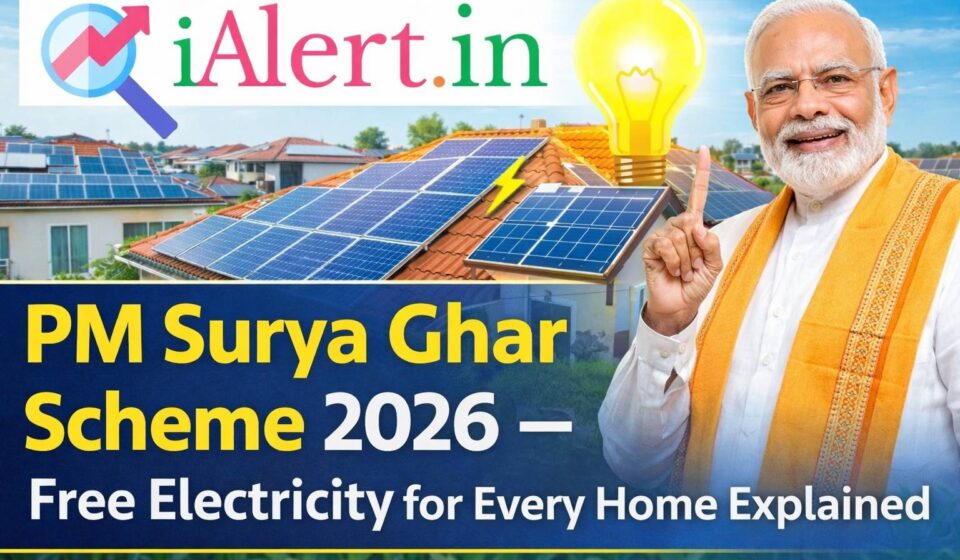
PM Surya Ghar Scheme 2026 – Free Electricity for Every Home Explained

Table Of Content
- Key Highlights – PM Surya Ghar: Muft Bijli Yojana (2026)
- Who Is Eligible? (Very Inclusive in 2026)
- How Much “Free Electricity” Do You Actually Get?
- Subsidy Breakdown (Unchanged in 2026 – Max ₹78,000)
- Step-by-Step Application Process (100% Online)
- Required Documents (Keep Ready)
- Q&A – Most Asked Questions in 2026
- Final Thoughts
Punjab’s electricity bills are brutal in summer — fans, ACs, coolers running non-stop can easily push monthly bills to ₹4,000–₹8,000+ for average households. The PM Surya Ghar: Muft Bijli Yojana is the government’s flagship answer: install rooftop solar panels, generate your own electricity, get up to 300 units completely free every month through net metering, and claim a direct subsidy up to ₹78,000 in your bank account.
This scheme is exploding in popularity across India in 2026 — especially in sunny states like Punjab — because real families are posting massive bill reductions (50–100% savings) and near-zero electricity costs after installation.
Here’s the complete, up-to-date explanation for 2026 — who qualifies, how much you really save, how to apply, and why it’s one of the best government schemes for middle-class homes right now.
Key Highlights – PM Surya Ghar: Muft Bijli Yojana (2026)
| Aspect | Details |
|---|---|
| Scheme Name | PM Surya Ghar: Muft Bijli Yojana |
| Launch Year | February 2024 (ongoing & accelerated in 2026) |
| Total Outlay | ₹75,021 crore (till FY 2026-27) |
| 2026-27 Budget | ₹22,000 crore (increased allocation) |
| Target | 1 crore households by 2026-27 |
| Progress | 26+ lakh households benefited; 20+ lakh installations completed; ₹14,771+ crore subsidies disbursed |
| Free Electricity | Up to 300 units per month offset via net metering |
| Max Subsidy | ₹78,000 per household (Central Financial Assistance – CFA) |
| Official Portal | https://pmsuryaghar.gov.in/ |
| Consumer Application | https://consumer.pmsuryaghar.gov.in/ |
| Helpline | 15555 (toll-free) |
Who Is Eligible? (Very Inclusive in 2026)
No income certificate, no BPL restriction — almost any homeowner can apply.
| Criterion | Requirement |
|---|---|
| Property | Own a residential house (individual house or flat in society) with suitable rooftop |
| Rooftop Condition | Shadow-free, structurally strong enough for panels (DISCOM feasibility check) |
| Electricity | Valid domestic grid-connected connection in your name (PSPCL in Punjab) |
| Citizenship | Indian resident |
| Income | No income limit — open to poor, middle-class & higher-income families |
| Not Eligible | Renters (need owner consent/ownership), commercial/industrial properties, no suitable roof |
How Much “Free Electricity” Do You Actually Get?
- Net Metering Magic: Solar panels generate power → used first in your home → excess goes to grid → credited to your bill at PSPCL rates (usually ₹2–4 per unit).
- Free Units Rule: Up to 300 units per month consumption is effectively free if your system generates enough (or more) than you use.
- Real Savings Example (Ludhiana 3 kW system):
- Average generation: ~12–15 units/day → 360–450 units/month
- If your home uses 300–400 units → bill drops to almost zero most months
- Excess sold back → extra ₹500–₹1,500/month credit in some cases
Subsidy Breakdown (Unchanged in 2026 – Max ₹78,000)
| System Size | Central Subsidy (CFA) | Approx. % of Cost Covered |
|---|---|---|
| 1 kW | ₹30,000 | ~50–60% |
| 2 kW | ₹60,000 | ~50% |
| 3 kW | ₹78,000 | ~40–50% |
| >3 kW | Capped at ₹78,000 | Lower % for larger systems |
- Typical 3 kW system cost in Ludhiana: ₹1.2–1.8 lakh
- After subsidy: ₹40,000–1 lakh net out-of-pocket
- Payback period: 4–6 years (faster with high usage)
Step-by-Step Application Process (100% Online)
- Visit https://consumer.pmsuryaghar.gov.in/
- Register with mobile number → OTP verification
- Enter PSPCL consumer number, address, preferred system size (kW)
- Upload documents: Aadhaar, recent electricity bill, roof photo, bank details
- Submit → PSPCL checks roof feasibility (7–15 days)
- Choose empanelled vendor from portal list (mandatory DCR/ALMM panels)
- Vendor installs + net meter setup
- Commissioning proof uploaded → subsidy credited to bank in 30 days
Required Documents (Keep Ready)
- Aadhaar Card (linked to mobile)
- Latest electricity bill (consumer number is key)
- Bank account details (for DBT subsidy)
- Recent clear roof photographs (multiple angles)
Q&A – Most Asked Questions in 2026
Q1: Is electricity really free?
A: Up to 300 units/month offset if generation ≥ consumption. Excess credited or sold — many pay almost nothing.
Q2: Can I apply if I’m middle-class?
A: Yes — no income limit. Scheme is open to all residential owners.
Q3: Renters eligible?
A: No — ownership or owner consent required.
Q4: How long till subsidy comes?
A: 30 days after successful commissioning & verification.
Q5: Punjab/Ludhiana advantage?
A: Excellent sunlight (4–5 units/kW/day), fast PSPCL net metering, high summer usage = quicker payback.
Q6: Fraud warning?
A: Completely free application on official portal. Never pay agents.
Final Thoughts
In 2026, PM Surya Ghar is one of the most practical and trending government schemes — literally turning your rooftop into a money-saving asset. With ₹22,000 crore funding boost this year and lakhs already saving big, now is the perfect time to apply before summer bills hit hard.
If you own your home in Ludhiana and have roof space — go to https://pmsuryaghar.gov.in/ today. It takes just minutes to start and could eliminate most of your electricity expense for the next 25 years.
Share this with family or friends in Punjab who are tired of high bills!
Questions? Drop them below or call 15555.
Always verify latest details on the official portal. Sources: MNRE, pmsuryaghar.gov.in, myScheme.gov.in, PIB releases, Feb-March 2026 updates.